
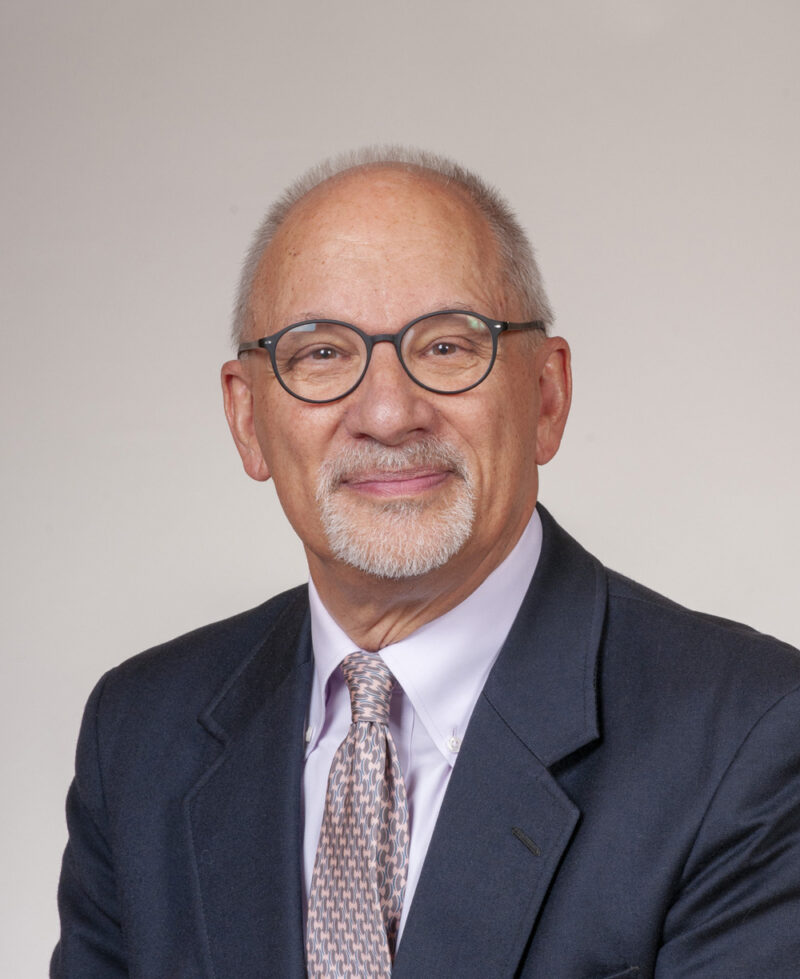
Mark Edelman (courtesy UMKC)
With deep pockets, deep knowledge and unbridled enthusiasm, Edelman has immeasurably improved the life of theater in KC – and beyond
Here’s a “what if” for you: What would the Kansas City theater scene look like if Mark Edelman never existed?
If you prefer a less metaphysical question, then consider this: What if his parents, instead of taking him to see the 1966 production of Marat/Sade at the old Missouri Repertory Theatre (where the scowling visage of the powerful actor Robert Elliott made an indelible impression on the teenager) had planned a different sort of outing? A ball game? A movie? An art museum?
It doesn’t matter. Because at the Rep — back when it performed in an unair-conditioned space people called the Quonset Hut — Edelman’s future course was set.
“It was a wow moment for me,” he said.
The result: Edelman became a lifelong theater lover — and, eventually, a successful presenter who would help shape the theater scene in Kansas City and elsewhere. In high school he painted sets for the Barn Players when the troupe still performed in an old horse barn in Prairie Village. After high school he earned a Bachelor of Arts degree in performing arts at Washington University in St. Louis. After that he wanted to enroll in film school — he had made a few short movies in college — but his mother persuaded him to choose a more “practical” route and get a law degree.
“My mother said, ‘Mark. You can always be a filmmaker if you go to law school, but you can never be a lawyer if you go to film school,’” Edelman recalled.
So Edelman got his law degree. His legal training prepared him to decipher showbiz contracts when he began booking Broadway shows.
Edelman’s debut as a presenter came in 1974.
“The first tour I ever presented was called National Lampoon’s Lemmings,” Edelman said. “It sold out the Music Hall… It was a spoof of Woodstock, very much like Christopher Guest’s movies.”
Guest, of course, would later co-star in Rob Reiner’s This Is Spinal Tap and would go on to direct his own “mockumentaries,” including Waiting for Guffman and A Mighty Wind. But before he was known for making movies, he was one of the stars of Lemmings, along with Chevy Chase and John Belushi.
The tour, apparently, was presented under the auspices of UMKC. The show faced some stiff competition that night because concert promoter Chris Fritz was presenting Dave Mason at Memorial Hall in Kansas City, Kansas. Edelman said the Mason concert sold out, too.
After Lemmings, the cast gathered at Edelman’s little apartment at 44th and Walnut. “It was so long ago that people were rolling joints with dollar bills,” Edelman recalled.
When Edelman decided that presenting musical theater was the way to go, he formed Theater League, a not-for-profit. He began bringing Broadway shows to the local market and found a willing audience. But that’s not all he did. He gradually expanded Theater League’s range to include other cities in the Midwest, the West and the South. And he initiated programs through Theater League to benefit students. And he began making financial contributions to area theater companies, large and small.
The league’s first presentation in Kansas City was the road company of Grease at the old Lyric Theatre at 10th and Central. Soon after came the national tour of A Chorus Line, one of the longest-running shows in Broadway history.
“Appropriately enough, it was a touring production of A Chorus Line that back in 1978 convinced Edelman that the newly formed Theater League had a future,” Robert W. Butler, the Kansas City Star’s former longtime movie and theater critic, wrote in 2018 when Edelman retired from Theater League. “After more than a decade of theatrical near-drought in which only a couple of Broadway shows would play in Kansas City each year — and then for only a night or two — he realized the city had a vast untapped market for the glitz and glamor of the Great White Way.”
Yes, it was Theater League that brought many shows — big shows with theme-park level illusions, such as Les Miserables and Phantom of the Opera — to Kansas City audiences for the first time.
But in the early days, finding a regular venue was a challenge.
“We did The Wiz at the Music Hall but most of the time we couldn’t get into the Music Hall,” he said.
That reason was that the Music Hall, the main performance venue in Municipal Auditorium, was the regular venue for the old Kansas City Philharmonic. When the Philharmonic disbanded and was replaced by the Kansas City Symphony in 1982, the Lyric became the main venue for the orchestra. That, in turn, freed up the Music Hall. Until then, however, Edelman had to fit touring Broadway shows into the Midland, a former vaudeville and later movie theater. It was virtually a feat of magic to fit the massive, complicated scenery of Les Miserables into the Midland, but the touring company found a way.
“Then we played everything we could at the Midland until Phantom,” Edelman recalled. “The Midland was way too small for that show.”
After Phantom, which played about seven weeks at the Music Hall, it became the league’s regular venue in Kansas City.
At Theater League, Edelman began early on to help out Equity theaters, many of them mid-sized, with annual cash grants. Occasionally the organization would pay for specific improvements — such as new theater seats in one of the Unicorn Theatre’s two venues. Other recipients include national organizations, such as Theatre for Young Audiences/USA, a national service organization for young-audience theaters founded in 1965. Theater League also gives money to 30 Shakespeare companies as well as to organizations supporting theater companies of color.
“We give away about $1.2 million a year, more than half to Kansas City companies,” Edelman said. “Those are operating funds and once in a while we give money for specific needs.”
Edelman wants people to understand something about the financial success and good works of Theater League: He didn’t do it alone. It would have been impossible without shared leadership of the organization, which included for many years his late mother-in-law, Beverly Lichterman. Lichterman was the league’s business manager for 27 years. She eventually retired and passed away in 2019 at the age of 91. Edelman met his late wife, Karin Lichterman, at the old Bijou movie theater in Westport, where she sold tickets, worked the concession stand and ran the projector. Karin, who shared Edelman’s enthusiasm for the theater, succumbed to cancer in 2022 at the age of 69.
“Karin and Bev were the most important people in my adult life,” Edelman said.
At one point, he said, his sister-in-law worked in the box office.
“It was really kind of a family affair and it would have really been hard to do it in any other way,” Edelman said. “It was very fortuitous. And they loved the theater, long before they met me.”
Edelman retired from Theater League, where he held the titles of president and CEO, in 2018. But the booking and presenting responsibilities were transferred to the American Theatre Guild, which was established in 2014. The charitable aspects of Theater League — making tickets available to underprivileged school kids, issuing grants to local theater companies — were all inspired, at least indirectly, by the legendary New York producer Joe Papp. Papp founded Shakespeare in the Park, produced A Chorus Line and contributed to efforts to preserve the Broadway theater district in New York.
“I was an admirer,” Edelman said. “I never met Mr. Papp but I was inspired by what he did to create cultural and entertainment programs and make it available to everyone possible.” (The late Marilyn Strauss, founder of the Heart of America Shakespeare Festival, also credited Papp’s work as a source of inspiration.)
Amy Hamm, executive director of the American Theatre Guild, said she had worked for and with Edelman for 18 years. The Guild is now the corporate entity bringing Broadway theater to Kansas City and many other markets. But it also continues the charitable work to underserved communities and schools with students from low-income families.
“When I worked for Mark I was frequently encouraging him to tell all the people all the things he was doing behind the scenes,” Hamm said. “There was a level of humility you don’t really see in our industry any more… It takes so much perseverance and for him to have done this for 40 years.”
Hamm added that Edelman’s efforts to bring Broadway theater to medium-sized cities and regions that for decades weren’t considered viable markets for Broadway shows are easily overlooked. What the Guild does now is only possible because of the decades of work Edelman devoted to extending the reach of Broadway theater, according to Hamm.
“If he hadn’t put all that grit and passion and perseverance into bringing Broadway to these communities over decades, we wouldn’t have had the opportunity to continue that impact and continue his legacy,” Hamm said. “I think it’s really cool.”
But Edelman’s efforts are ongoing. As Libby Hanssen reported in the May/June issue of KC Studio, the Mark Edelman Theater Fund was established in 2025 with a $20 million grant from Theater League to support live theater in Kansas City, the U.S. and Canada. Hanssen wrote that the fund had donated $1 million to the UMKC Conservatory. The fund is administered by the Jewish Community Foundation of Greater Kansas City.
These days Edelman lives in the Alexandria, Virginia, area — a move that puts him close to his adult son, CJ, and daughter, Risa, and their families. He writes a theater column that he syndicates to newspapers in the Washington, D.C., area and hosts a monthly podcast on theater. He is a Tony Awards voter (and has been for many years) and sees about 90 plays a year — on average, two or three plays a week.
Neither of his kids are involved in theater. “They thought working in the theater involved a let of yelling,” Edelman said. “The kids may have seen the less pleasant side of Daddy doing business.”
In addition to Kansas City, the American Theatre Guild presents touring Broadway musicals in the following markets: Birmingham, Alabama; Santa Barbara, California; Thousand Oaks, California; Colorado Springs, Colorado; Melbourne, Florida; Peoria, Illinois; South Bend, Indiana; and Toledo, Ohio.
Editor’s note: Mark Edelman Theater League is a generous donor to KC Studio.